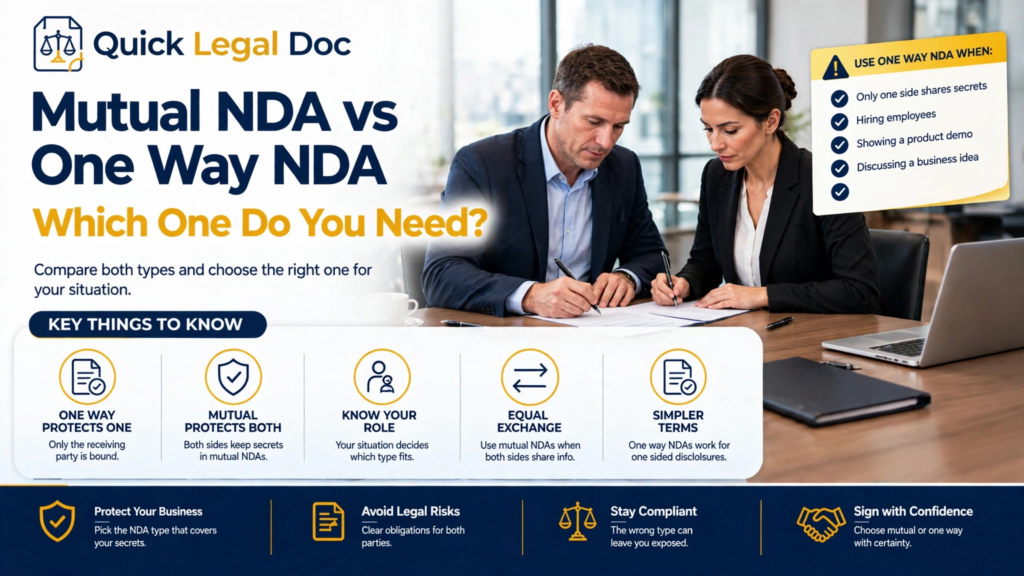
A one way NDA protects information flowing in one direction, from you to the other party. A mutual NDA protects both sides, which you need whenever you will each be sharing sensitive information. Pick the type that matches the actual flow of information, not the one that sounds stronger.
This article breaks down the mutual vs unilateral NDA choice the way it comes up in real deals. You will learn what each type covers, when each one fits, what goes wrong when you choose badly, and how to make the decision in about two minutes.
What Is the Mutual vs Unilateral NDA Difference Really About?
A one way NDA, also called a unilateral NDA, has a disclosing party and a receiving party. One side shares secrets, the other side promises to keep them. The obligations run in a single direction. Think of a job candidate signing an NDA before hearing about your unreleased product, or a freelancer agreeing to keep your client data private.
A mutual NDA binds both sides. Each party may share confidential information, and each promises to protect what it receives. The obligations mirror each other. Think of two companies exploring a partnership, where each will open its books, its roadmap, or its technology to the other.
The labels matter less than the mechanics. What counts is who is disclosing, who is receiving, and whether the obligations are balanced. Once you see the flow of information clearly, the right document usually picks itself.
When Does a One Way NDA Make Sense?
A one way NDA fits any situation where only one side is sharing. Hiring is the classic case: the company discloses, the candidate listens. The same goes for contractors brought in to work on your systems, vendors evaluating your data, or investors hearing your pitch. In each case, the information moves one way, so the protection should too.
One way NDAs are simpler to negotiate. There is no haggling over balanced terms because only one party takes on obligations. The disclosing party sets the scope, the duration, and the rules, and the receiving party either accepts or walks away. For routine hires and standard vendor relationships, that simplicity is a feature.
Do not use a one way NDA out of habit when the reality is two sided. If your contractor will also be sharing their proprietary methods with you, or your investor will be telling you about their portfolio companies’ strategies, a one way agreement leaves one side exposed. Match the document to the reality.
When Do You Need a Mutual NDA Instead?
You need a mutual NDA whenever both sides will share sensitive information. Partnership talks, joint ventures, merger discussions, and co-development projects almost always qualify. Each party opens up, so each party needs protection. A one way NDA in these situations is not just incomplete, it is unfair, and the unprotected side will usually refuse to sign it.
Mutual NDAs also smooth the conversation. When both sides are bound by the same rules, people talk more freely, which is the whole point of early business discussions. Nobody holds back for fear that their openness is not reciprocated. The symmetry builds trust before the deal does.
Cornell Law School’s Legal Information Institute keeps a helpful overview of nondisclosure agreements that explains the structure of these obligations, useful background when you are deciding whether your situation calls for one sided or two sided protection.
Watch for fake mutuality, though. Some agreements labeled mutual are drafted so that, in practice, only one side ever discloses anything. The label does not hurt, but do not let it fool you into thinking you are protected when you never actually shared anything worth protecting.
What Goes Wrong When You Pick the Wrong Type?
Using a one way NDA for a two way conversation leaves one party unprotected. Imagine a partnership discussion where you both share roadmaps, but only the other side signed as the receiving party. Your roadmap is protected. Theirs is not, or worse, you disclosed yours under rules that do not bind them the way you assumed. The misunderstanding usually surfaces at the worst possible moment.
Using a mutual NDA for a one way situation is less dangerous but still sloppy. It can confuse everyone about who owes what, and it gives the receiving party rights and carve outs they did not need. In employment contexts it can even look odd, an employee “disclosing” trade secrets back to the employer under a mutual NDA raises questions nobody wants to answer.
The fix is simple: before anyone signs, ask who will actually be sharing confidential information. If the answer is one party, go one way. If the answer is both, go mutual. The mutual vs unilateral NDA question is really just a question about the direction of the information flow.
Can You Convert a One Way NDA Into a Mutual NDA Later?
Yes, but do it in writing before the new disclosures happen, not after. If a vendor relationship starts with you sharing specs under a one way NDA, and later the vendor needs to share their proprietary process with you, sign a mutual NDA or an amendment before that second conversation. Disclosures made before the paperwork exist in a gray area nobody enjoys litigating.
The cleanest approach is to start mutual when you suspect the relationship will become two sided. Many business relationships evolve, a vendor becomes a partner, a candidate becomes a co-founder. A mutual NDA signed at the start covers the evolution without anyone having to stop and re-paper midstream.
That said, do not default to mutual for everything. For straightforward hiring and standard contractor work, a one way NDA is cleaner, faster, and easier to explain. Upgrade to mutual when the facts change, not before.
How Do You Decide Which One You Need in Two Minutes?
Ask one question: will the other side be sharing their confidential information with me, or only receiving mine? If only receiving, you need a one way NDA. If sharing too, you need a mutual NDA. That single question resolves the vast majority of cases.
Then sanity check the answer against the relationship. In consulting engagements, for example, the consultant often shares proprietary methodology while the client shares internal data, a genuinely two way flow that calls for mutual protection. Our consulting agreement guide walks through how confidentiality fits into these relationships, which helps you see whether your situation is really one sided.
Finally, read the draft with fresh eyes before signing. Check that the defined disclosing and receiving parties match reality, that the obligations run in the right direction, and that the scope covers what will actually be shared. Two minutes of reading now saves months of arguing later.
Where Can You Get the Right NDA Without Overthinking It?
You do not need to agonize over this choice. The Quick Legal Doc NDA generator asks whether the agreement should protect one side or both, then builds the right document around your answer in plain language. You pick the direction, set the scope and duration, and get a clean agreement in minutes.
That is the real lesson of the mutual vs unilateral NDA debate. The type matters, but getting it right is easy once you look at the information flow. Choose honestly, write it clearly, and sign before anyone shares anything sensitive.
Frequently Asked Questions
Q: What is the main difference in a mutual vs unilateral NDA?
A: A unilateral, or one way, NDA protects information flowing in one direction, with one disclosing party and one receiving party. A mutual NDA binds both sides, so each party protects the confidential information it receives from the other. The difference is entirely about the direction of the obligations.
Q: Is a mutual NDA stronger than a one way NDA?
A: Not stronger, just broader. A mutual NDA covers two directions of disclosure instead of one, but each direction gets the same level of protection as a well-drafted one way NDA. Choose based on the information flow, not on which sounds more powerful.
Q: Do employees sign mutual or one way NDAs?
A: Almost always one way. The employer discloses, the employee receives and promises confidentiality. A mutual NDA for a regular employee is unusual and can create confusion about obligations that were never meant to exist.
Q: Can a mutual NDA protect me if only I shared information?
A: Yes, the mutual structure still protects your disclosures even if the other side never shares anything back. The obligations simply sit unused on their side. It is harmless overkill, though a one way NDA would have been simpler.
Q: What happens if we signed a one way NDA but both shared secrets?
A: The party who was not protected as a discloser may have no contractual remedy for the other’s use of their information. The fix is to sign a mutual NDA or amendment covering future disclosures, and to get legal advice about anything already shared.
The templates and articles on Quick Legal Doc are provided for informational purposes only and are not legal advice. Every business situation is different, so consult a licensed attorney in your state before relying on any NDA for your specific circumstances.