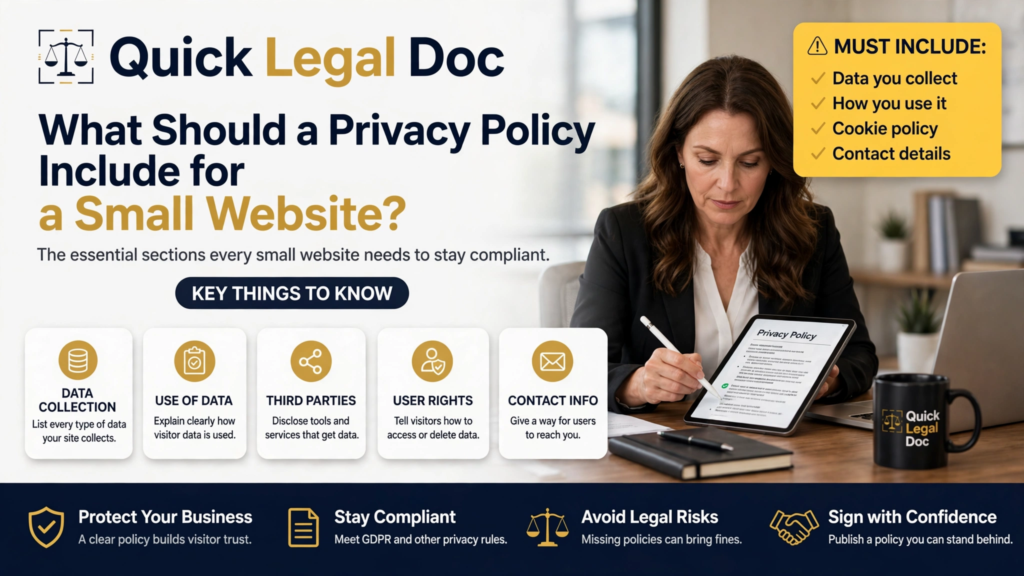
A privacy policy for a small website should include what data you collect, how you collect it, how you use it, who you share it with, how you protect it, what rights visitors have over their data, and how to contact you. Even a simple site with just a contact form needs to cover these basics honestly.
This article walks through what should a privacy policy include section by section, in plain language. You will learn what each part needs to say, which mistakes small site owners make most often, and how to end up with a policy that is both compliant and readable.
What Should a Privacy Policy Include About Data Collection?
Start with an honest inventory of what your site actually collects. Most small websites gather more data than their owners realize: names and email addresses from contact forms, IP addresses and browser details in server logs, analytics data about which pages people visit, and payment details if you sell anything. Your policy must list all of it, not just the obvious parts.
Be specific about how each type of data is collected. A contact form collects information the visitor types in directly. Analytics tools collect it automatically in the background. Cookies store it on the visitor’s device. People reading your policy want to know not just what you take, but how you take it, and vagueness here is what gets small sites in trouble.
The most common mistake is copying a policy that describes data collection your site does not do, while omitting the collection it actually does. If you run analytics, say so. If you do not sell anything, do not include three paragraphs about payment processing. Accuracy beats length every time.
How Should You Explain Cookies and Tracking?
Your policy needs a section on cookies and similar tracking technologies, because nearly every small website uses them. Analytics cookies, advertising cookies, social media embeds that set their own cookies, even the basic cookies your platform uses to keep the site running, all of it belongs in this section.
Explain what each category does in plain terms. Essential cookies keep the site working. Analytics cookies help you understand traffic. Advertising cookies support ads. You do not need to name every single cookie, but visitors should finish the section understanding the categories and their purposes.
Note that cookie rules go beyond the policy itself in some regions. Visitors in the EU, for example, generally need to consent before non-essential cookies are set, which means a cookie banner working alongside your policy. The policy explains, the banner asks permission, and the two should agree with each other.
What Should the Policy Say About How You Use the Data?
For every type of data you collect, state the purpose. Contact form submissions are used to respond to inquiries. Email addresses are used to send newsletters, but only if the visitor opted in. Analytics data is used to improve the site. Payment information is used to process orders. One purpose per data type, stated plainly.
This is where many small-site policies go wrong by being too broad. Language like “we may use your data to improve our services” says nothing and protects no one. Regulators and readers alike prefer concrete statements: we use your email to reply to your message, and we do not add you to a marketing list unless you ask.
Also cover how long you keep data. Contact form messages might be kept for a year, analytics data for a set retention period, account information for as long as the account exists. A retention statement shows you have thought about data minimization, which is exactly what privacy laws expect.
Do You Need to Cover Third-Party Sharing?
Yes, and this section surprises the most small site owners. Even if you never sell data, your site almost certainly shares it with third parties: your hosting provider, your analytics service, your email newsletter platform, your payment processor, embedded YouTube videos or social feeds. Each of these receives some visitor data, and your policy must say so.
List the categories of third parties and why they get the data. Your email platform receives addresses to send newsletters. Your analytics provider receives usage data to generate reports. Your payment processor receives order details to charge cards. Name the services where practical, since visitors increasingly expect transparency here.
The California Attorney General’s office maintains clear guidance on the California Consumer Privacy Act, which is worth reviewing because its disclosure rules apply to many small sites with California visitors, not just large companies. Understanding what counts as a sale or share of data under these rules shapes how you write this section.
Be direct about what you do not do, too. If you never sell personal information, say so plainly. That single sentence answers one of the most common reader questions and builds trust faster than three paragraphs of legal hedging.
What Rights Do Visitors Have Over Their Data?
Modern privacy laws give visitors rights over their personal information, and your policy must explain them. The core rights are consistent across most laws: the right to know what you have collected, the right to request deletion, the right to correct inaccuracies, and the right to opt out of certain uses like targeted advertising.
Explain how a visitor actually exercises these rights. Provide an email address or a form, state how long a response takes, and say whether you need to verify their identity first. A list of rights with no way to use them reads as decorative, and regulators notice.
Keep the rights section matched to reality. If you are a tiny blog with a contact form, your obligations are lighter than a store with ten thousand customers, but the rights still exist for your visitors. Describe what applies to you honestly rather than pasting in a section written for a different kind of business.
How Do Updates and Contact Details Fit In?
Every policy needs a last-updated date and a promise about future changes. State that you may update the policy as your practices change, explain how you will notify visitors of material changes, by posting the new version prominently or emailing subscribers, and note that continued use of the site means acceptance. Then actually follow through when you change something meaningful.
Include real contact information for privacy questions. A dedicated email address is the minimum. Visitors exercising their rights, or just confused about a section, need somewhere to reach a human. A policy with no contact point looks unfinished and undermines everything above it.
If you are wondering whether your small site even needs all of this, our guide on whether you need a privacy policy walks through the triggers, from contact forms to analytics to ad networks, that make a policy legally necessary.
Where Can a Small Site Owner Get a Proper Policy?
You do not need to hire a lawyer to cover the basics well. The Quick Legal Doc privacy policy generator asks about your site in plain language, what you collect, which tools you use, whether you run ads, and builds a complete policy covering every section above. It takes minutes and reflects what your site actually does.
That is the standard to hold any privacy policy to: honest about collection, clear about use, upfront about sharing, and specific about rights. Write it for a real visitor reading it with real questions, not for a regulator you hope never reads it.
Frequently Asked Questions
Q: What should a privacy policy include at a minimum?
A: At a minimum, it should state what data you collect, how you collect it, how you use it, who you share it with, how you protect it, how long you keep it, what rights visitors have, and how to contact you. Even the simplest site needs these building blocks.
Q: Does a small blog with no ads need a privacy policy?
A: If it has a contact form, comments, or analytics, yes. Any collection of personal information, even just names and email addresses from a form, triggers the need for a policy under most privacy laws. Traffic volume does not determine the obligation.
Q: How long should a small website privacy policy be?
A: Long enough to be honest, short enough to be read. Most small sites are well served by one to two pages covering the sections above in plain language. Padding it with irrelevant clauses makes it less trustworthy, not more.
Q: Do I need a lawyer to write my privacy policy?
A: For a typical small site, a well-built generator plus your own honest answers about your practices is enough. If you handle sensitive data like health or financial information, operate in multiple regulated regions, or have unusual data practices, legal review is worth the cost.
Q: Should my privacy policy mention specific company names?
A: Naming your key third-party services, like your analytics or email platform, adds credibility and transparency. At minimum, describe the categories of third parties clearly. Named services are better, categories are acceptable, silence is not.
The templates and articles on Quick Legal Doc are provided for informational purposes only and are not legal advice. Every business situation is different, so consult a licensed attorney in your state before relying on any privacy policy for your specific circumstances.