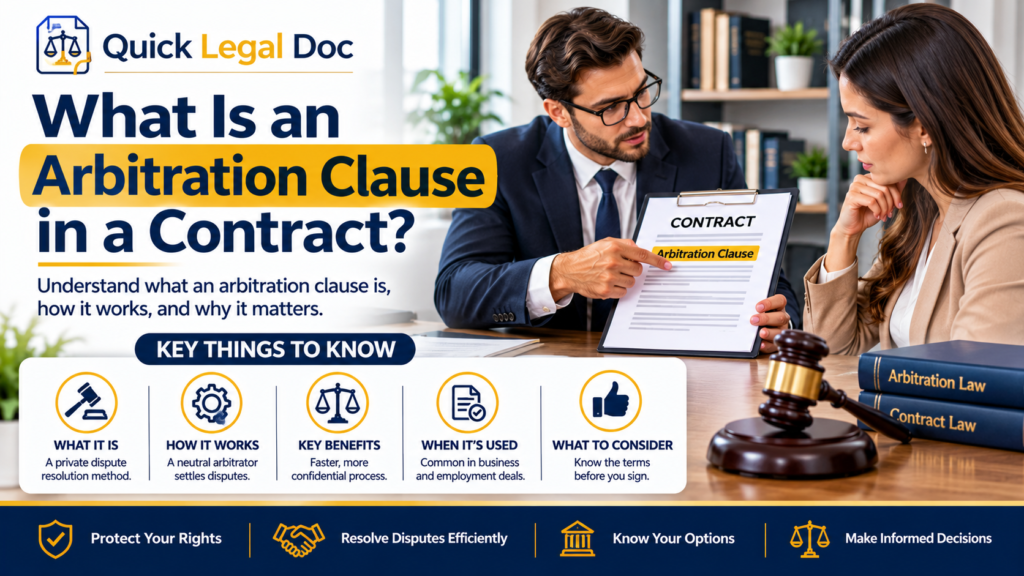
You are about to click I agree on a new subscription or you are signing a job offer. Somewhere in the fine print is a paragraph saying any dispute goes to arbitration. What is an arbitration clause? It is a contract term that requires you to settle future disputes with a private arbitrator instead of suing in court and it usually applies even if you never noticed it. Most people only learn what it means after something goes wrong.
This guide explains how an arbitration clause works, what you give up, when it can be challenged and how to spot one that is stacked against you.
What Is an Arbitration Clause?
An arbitration clause is a section of a contract in which both sides agree that disputes will be decided by an arbitrator, who is a neutral third party, instead of a judge or jury. The arbitrator hears both sides, reviews the evidence and issues a decision called an award. That award is usually final and binding.
You will find an arbitration clause in employment agreements, app and software terms, credit card and bank agreements, gym memberships, freelance contracts and many business contracts. Sometimes it sits under a heading like dispute resolution. Sometimes it is just a few sentences near the end.
How Is Arbitration Different From Going to Court?
Arbitration is a private process. There is no jury, the rules of evidence are looser and the exchange of documents before the hearing is usually more limited than in a lawsuit. Hearings are often held in an office or by video and the outcome is typically kept out of the public record.
Supporters say arbitration is faster and cheaper than litigation. That is often true for smaller disputes, but not always. Arbitrator fees can be significant and an award can be very hard to appeal even if you think the arbitrator got it wrong.
Are Arbitration Clauses Legally Enforceable?
Usually yes. The Federal Arbitration Act, passed in 1925, makes written arbitration agreements valid and enforceable, with the same exceptions that apply to any other contract. Courts routinely send disputes to arbitration when the contract says so.
A court can still refuse to enforce an arbitration clause for ordinary contract reasons. Examples include fraud, a lack of real agreement or terms so one-sided that they are considered unconscionable. These challenges can work, but they are hard to win.
What Do You Give Up With an Arbitration Clause?
In practice, agreeing to arbitrate means giving up four things: the right to a jury, a public court process, most of the broad discovery tools used in lawsuits and in many cases the right to appeal. For a small dispute that may be a fair trade. For a large or complicated one, it can change the odds.
The Class Action Waiver Hiding Inside
Many arbitration clauses include a class action waiver. This is a promise that you will bring any claim on your own and not as part of a group. The Supreme Court has upheld class waivers in arbitration agreements, so a clearly written one is usually enforceable. The practical effect is that small claims that are not worth pursuing alone may never be pursued at all.
The Federal Exception Most Guides Skip
A 2022 federal law changed the rules for one category of claims. Under the Ending Forced Arbitration of Sexual Assault and Sexual Harassment Act, a person who alleges sexual harassment or sexual assault can choose to void a pre-dispute arbitration agreement or class waiver and bring the case in court instead. The law applies to claims that arise on or after March 3, 2022 and you can read the statute on Cornell Law School’s page for 9 U.S.C. 402.
Two details matter. First, the choice belongs to the person making the claim, not the employer. Second, a court, not an arbitrator, decides whether the law applies, even if the contract tries to hand that question to the arbitrator. Some courts have read the law to keep the whole case out of arbitration, not only the harassment claim, so the details can matter. Parties can still agree to arbitrate after a dispute arises, but that is a separate decision made with open eyes.
Can You Opt Out of an Arbitration Clause?
Some contracts include an opt-out window. If yours does, it is the cleanest way out. These windows are often short, commonly around 30 days from signing or sign-up, though the length varies. The clause will say how to opt out, usually by sending written notice to a named address or email.
Follow the instructions exactly and keep proof that you sent the notice. Opting out normally removes only the arbitration clause and the rest of the contract stays in force. If there is no opt-out window, your main options are to negotiate before signing or to decline the deal.
What Does Arbitration Cost?
Costs vary by provider and by type of dispute. Many arbitration providers have consumer and employment rules that limit what the individual pays and make the company cover most of the fees. Business contracts are different and each side often pays a share of the filing and arbitrator fees. Read the fee terms in your arbitration clause, because a clause that makes you pay all the costs is a warning sign.
Arbitration vs Mediation: Not the Same
Mediation and arbitration are often mentioned together but work differently. In mediation, a neutral person helps both sides try to reach a settlement and nothing is binding unless both agree. In arbitration, the neutral person decides the outcome. Many contracts require mediation first and arbitration second, which gives both sides a chance to settle before a formal hearing.
Red Flags in an Arbitration Clause
Not every arbitration clause is unfair, but some are written to favor one side. Watch for these warning signs:
- Only one side is required to arbitrate
- The hearing must take place in a distant city
- The company picks the arbitrator or the provider
- Very short deadlines to start a claim
- You must pay all the fees
- A delegation clause that lets the arbitrator decide whether the clause itself is valid
Our guide on what red flags to look for in a contract covers more warning signs worth checking before you sign.
Can You Negotiate an Arbitration Clause?
Yes, especially in freelance, consulting and business agreements. Common requests are to make the clause mutual, to move the hearing to a location that works for both sides, to require mediation first and to carve out small claims court for smaller disputes. Many counterparties accept at least some of these changes.
If you write your own agreements, put the governing law and key terms in writing from the start. Our free Freelance Contract Generator helps you set those terms out in a few minutes, which gives you a clear base to negotiate from.
Common Mistakes to Avoid
The most common mistake is assuming an arbitration clause only matters if you plan to sue. It also decides how a dispute against you would be handled. Others include missing the opt-out deadline, ignoring the fee terms and assuming that signing electronically makes the clause less binding. Reading the dispute resolution section before you sign takes two minutes and can save months later.
Frequently Asked Questions
Q: Is an arbitration clause legal?
Yes, in most cases. The Federal Arbitration Act makes written arbitration agreements enforceable, though they can be challenged for fraud, unconscionability or other ordinary contract defenses.
Q: Can I still use small claims court if my contract has an arbitration clause?
Often yes, because many clauses carve out small claims. Check the exact wording, since some clauses do not.
Q: Can I opt out of an arbitration clause after signing?
Only if the contract offers an opt-out window and the deadline is usually short. Without one, you generally cannot opt out later.
Q: Is the result of arbitration final?
Usually yes. Courts can set aside an award only in limited situations, so appealing an arbitrator’s decision is much harder than appealing a court judgment.
Q: Does an arbitration clause apply to sexual harassment claims?
Not if the person making the claim chooses court. Under federal law, a pre-dispute arbitration agreement can be voided at that person’s election for claims that arise on or after March 3, 2022.