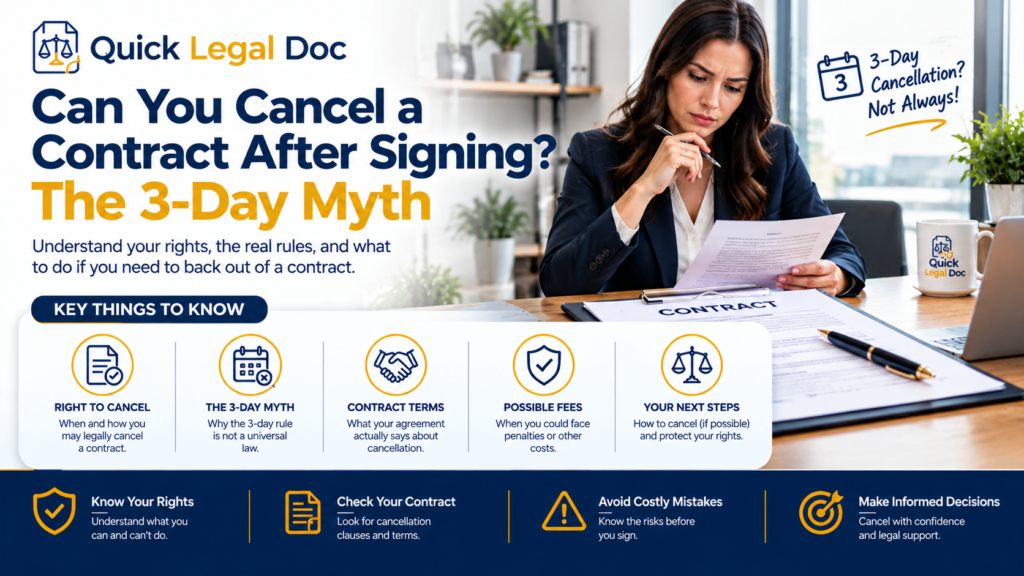
You signed the contract on Friday and by Sunday you regret it. The price feels too high, the salesperson was pushier than you remembered or you simply changed your mind. Can you cancel a contract after signing? In most cases, no, because there is no general legal right to back out of a deal just because you had second thoughts. The famous three-day cooling-off rule is real, but it covers far fewer situations than most people assume.
This guide explains when the cooling-off rule applies, what it leaves out and the other legal routes people use to cancel a contract they no longer want.
Is There a Legal Right to Cancel a Contract After Signing?
Once both sides sign, a contract is generally binding. Courts expect people to read before they sign and to honor what they agreed to. Changing your mind is not, on its own, a legal reason to cancel a contract.
There are exceptions, but each one is narrow. Some come from federal and state consumer protection laws. Others come from the contract itself or from basic contract law. The sections below take them one at a time.
How the FTC Cooling-Off Rule Works
The Federal Trade Commission’s Cooling-Off Rule gives you three business days to cancel a contract made in certain types of sales, for any reason. You don’t have to explain yourself and you get a full refund. It applies when a seller approaches you in person away from their normal place of business. That includes your home, your workplace or your dorm, as well as temporary locations like a hotel room, convention center or fairground.
The purchase also has to meet a minimum value. The rule covers sales of $25 or more made at your home and $130 or more made at a temporary location. Cornell Law School’s Legal Information Institute summarizes the rule and its limits in its entry on the cooling-off rule, which is a good starting point before you assume it covers your situation.
Sellers have duties too. At the time of sale, they must tell you about your right to cancel, give you a copy of the contract and hand over two copies of a cancellation form. A seller who skips these steps may be breaking the rule.
How Do You Count the Three Days?
Business days here means every day except Sundays and federal holidays, so Saturdays count. A contract signed on a Friday, with no holiday in the way, can be canceled until midnight on the following Tuesday.
To cancel a contract under this rule, send written notice and make sure it is postmarked by midnight of the third business day. Hand delivery works as well. Keep proof either way, such as a certified mail receipt or a dated copy of what you sent.
Once you cancel a contract properly, the seller has ten business days to refund your money, return any trade-in and cancel any note you signed.
A Quick Example
Say a salesperson visits your home on Thursday and you sign a $3,000 contract for new windows. Friday is business day one, Saturday is day two and Sunday doesn’t count, so Monday is day three. You would need to mail your written cancellation with a Monday postmark. If you wait until Tuesday, the cooling-off right is gone.
What the Cooling-Off Rule Does Not Cover
This is the part that trips people up. Many people believe they can cancel a contract for any purchase within three days and that belief has no basis. The rule does not apply to sales made entirely online, by mail or over the phone. It also doesn’t apply when you buy at the seller’s regular store or office. If you walked into the showroom yourself, the rule usually won’t help you cancel a contract.
There are other carve-outs as well, including insurance, securities, art and crafts sold at fairs and automobiles sold at temporary locations such as auto shows. Purchases below the dollar thresholds are left out too.
That means an online order for a $200 jacket gives you no federal right to cancel a contract within three days. Any return window you get comes from the store’s own policy, not from the law.
Other Three-Day Rights You Might Have
A few other laws give you a short window. Under the Truth in Lending Act, you generally have until midnight of the third business day to cancel a home equity loan or second mortgage secured by your home. That right is separate from the FTC rule and works differently.
Many states also have their own cancellation laws for specific industries. Health club memberships, dating services, weight loss programs, timeshares and hearing aids are common examples. The window and the rules vary by state, so check your state attorney general’s consumer protection page before you sign in those categories.
Other Legitimate Ways to Cancel a Contract
When no cooling-off right applies, you still have a few routes.
To cancel a contract the clean way, start with the contract itself. Many agreements include a termination clause that explains how either side can end things, often with written notice and sometimes a fee. If that clause exists, following it exactly is usually the cleanest exit.
You can also ask the other side to agree. A mutual cancellation, where both parties agree in writing to end the deal, is perfectly valid. It costs nothing to ask and many businesses would rather release you than deal with an unhappy customer.
A contract can also be voidable if it was signed because of fraud, a serious misrepresentation or duress or if one party lacked the legal capacity to agree, such as a minor. If the other side fails to deliver what they promised, you may be able to cancel a contract without penalty because of their breach.
Ending a lease early is a real-world example of how this plays out. Our guide on what happens if you break a lease early explains the costs and options tenants usually face when they want out before the term ends.
What It Can Cost to Walk Away Anyway
If none of these routes let you cancel a contract and you simply stop performing, you may be in breach. The other side can then claim damages, which usually means the money they lost because you backed out. Some contracts also include a cancellation fee or a liquidated damages clause that sets the amount in advance.
Before you walk away, try negotiating. Offer a partial payment, a shorter notice period or a replacement if that makes sense. A calm written offer usually gets better results than silence.
How to Protect Yourself Before You Sign
The best time to think about how you would cancel a contract is before you sign. Read the cancellation and termination sections first. Ask what fees apply if you back out, what happens to any deposit and how much notice is required. If a salesperson pressures you to sign today, treat that as a reason to slow down, not speed up. A legitimate offer will still be there tomorrow.
Take a copy of everything you sign. If the seller promised something verbally, ask them to add it to the contract. A promise that exists only in conversation is hard to prove later.
Build an Exit Into Your Own Contracts
If you’re the one writing the agreement, the easiest way to avoid fights over how to cancel a contract is to plan the exit up front. A clear termination clause, a notice period and a rule for what happens to deposits and unfinished work protect both sides. Our free Freelance Contract Generator includes termination terms, so you don’t have to draft them from scratch.
Common Mistakes to Avoid
The biggest mistake is assuming a three-day right exists when it doesn’t, then missing the real deadline for a different remedy. Others include waiting until day four, relying on a phone call instead of written notice, forgetting to keep proof and ignoring the contract’s own termination clause.
Frequently Asked Questions
Q: Can I cancel a contract after signing if I just changed my mind?
Usually not. Unless a cooling-off right, a termination clause or the other side’s agreement applies, a signed contract is binding.
Q: Does the three-day rule apply to online purchases?
No. The federal cooling-off rule doesn’t cover sales made entirely online, by mail or by phone. Any return window comes from the store’s own policy.
Q: Does the three-day rule apply when buying a car?
Generally no. A dealership is the seller’s normal place of business, so the rule doesn’t reach it and cars sold at temporary locations like auto shows are specifically excluded.
Q: Do Saturdays count as business days for the cooling-off rule?
Yes. Under the rule, business days are every day except Sundays and federal holidays.
Q: What if the seller refuses to honor my cancellation?
Keep proof that you sent notice on time, then report the problem to the FTC at ReportFraud.ftc.gov and to your state attorney general.