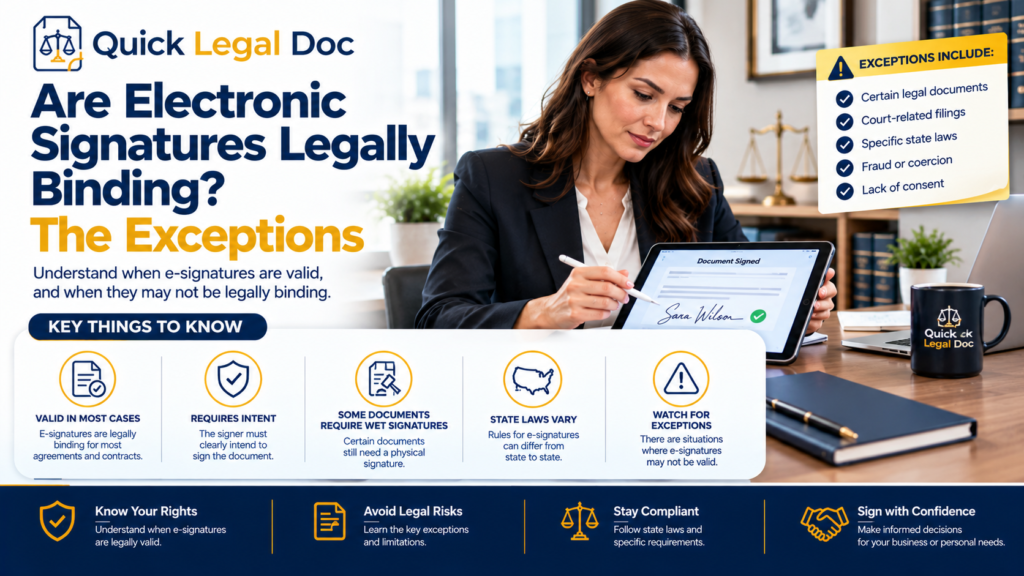
A client sends you a PDF and asks you to sign it by typing your name. It feels too casual to count. Are electronic signatures legally binding? Yes, in the United States electronic signatures carry the same legal force as handwritten ones for most contracts, as long as both sides agree to sign electronically. The catch is a short list of documents where the law still wants ink and paper.
This explains which laws make electronic signatures valid, what makes one enforceable, which documents are excluded and how to sign safely online.
What Laws Make Electronic Signatures Legal?
Two laws do the heavy lifting. The federal ESIGN Act, passed in 2000, says a signature or contract can’t be denied legal effect just because it is electronic. The Uniform Electronic Transactions Act or UETA, is a model law that 49 states and the District of Columbia have adopted. New York didn’t adopt UETA but has its own statute with a similar effect.
Between them, electronic signatures are valid in all 50 states. The ESIGN Act works as a federal baseline, so a signature doesn’t lose its force just because a state’s rules are thin.
What Makes an Electronic Signature Binding?
An electronic signature can be a typed name, a click on an I agree button, a drawn signature on a screen or even a recorded voice. The format isn’t what counts. The law looks at intent. In plain terms, an electronic signature is any electronic mark that is tied to a document and adopted by someone who meant to sign it.
In practice, courts look for four things: that you meant to sign, that everyone agreed to do business electronically, that the signature is clearly connected to the document and that a copy of the signed record can be kept and reproduced later.
The second point matters. Nobody can generally force you to use electronic signatures. If you would rather sign on paper, you can usually ask to do that.
Which Documents Can’t Be Signed Electronically?
The ESIGN Act does not cover everything. Section 7003 of the Act lists the exclusions and the full text is available on Cornell Law School’s page for 15 U.S.C. 7003. In plain language, the main exclusions are wills and testamentary trusts, most family law documents such as adoption and divorce papers and court orders and official court documents.
The list also includes several notices that affect basic needs. These are foreclosure or eviction notices for a primary residence, utility service cancellation notices and health or life insurance cancellation notices. Product recall notices and documents required for transporting hazardous materials are excluded too.
Wills deserve a special mention. They are excluded from ESIGN, but some states have since passed their own electronic will laws. If you’re working on estate documents, check your state’s rules before signing on a screen.
Do Both Parties Have to Agree to Use Electronic Signatures?
Yes, in a practical sense. Both sides need to be willing to use electronic records and signatures. For ordinary business contracts, that agreement is usually obvious from what people do. One side sends a link and the other clicks and signs.
Consumers get extra protection. When the law requires certain information to be given to a consumer in writing, the business has to get the consumer’s consent to electronic delivery first and explain their right to ask for paper copies.
A Quick Example
A freelance designer emails a contract. The client types their name, checks a box that says they agree to sign electronically and clicks submit. The signing platform records the time, the device details and the final signed PDF. That setup covers all four points: intent, consent, a clear link between signature and document and a saved copy. If the client later claims they never signed, that audit trail is exactly what a court would want to see.
Typed Name or Drawn Signature: Does It Matter?
Legally, no. A typed name and a drawn signature both count when the intent is there. In a dispute, though, the evidence around the signature matters more than how it looks. A drawn signature with a time-stamped record is easier to prove than a typed name in an email thread with no log.
Replying I agree to a clear written offer can still work as a signature for many contracts. It just leaves more room for argument later.
Electronic Signature vs Digital Signature
People use these terms as if they mean the same thing, but they don’t. An electronic signature is any electronic mark showing intent to sign. A digital signature is a specific type that uses cryptography and certificates to verify who signed and to detect tampering afterward. Digital signatures are stronger evidence, but the law doesn’t require them for ordinary contracts.
Will Electronic Signatures Hold Up in Court?
A court can’t throw out a signature just because it is electronic. The real question is proof. The person relying on the signature has to show it’s genuine and the usual evidence is a signing log with timestamps, the email trail and the platform’s completion certificate. Keeping those records alongside the signed document makes a challenge to electronic signatures far easier to defeat.
How to Use Electronic Signatures Safely
A few habits make electronic signatures much easier to defend. Use a tool that records who signed and when. Keep the final signed copy and the audit trail together. Make sure the version the signer saw is the version that was finalized. And never change terms after signing without getting a fresh signature.
A signature only matters if the contract behind it is sound. Our guide on how to make a contract agreement that holds up covers the terms worth settling before anyone signs, whether on paper or on a screen.
Does a Signed Document Still Need a Notary?
Notarization is a separate step from the signature itself. Many states now allow remote online notarization, but the rules vary and some documents still need a notary in person. If a document requires notarization, an electronic signature alone won’t be enough.
Creating Agreements You Can Sign Online
Once an agreement is drafted, sending it for electronic signature takes minutes. Our free Freelance Contract Generator builds a complete agreement you can save as a PDF and send to your client for signing.
Why Freelancers and Small Businesses Rely on Electronic Signatures
Electronic signatures remove the slowest part of closing a deal. There’s no printing, scanning or waiting for the mail. A contract that once took a week to circulate can be signed in an afternoon, even if the two sides are in different countries.
They also create a cleaner record than paper. A good platform logs every step, which gives both sides proof of what was signed and when. For freelancers and small businesses, electronic signatures are often the difference between starting a project on time and chasing a client for a signed copy.
When Paper Is Still the Smarter Choice
Electronic signatures are not always the right tool. If the other party prefers paper, if the document falls into one of the excluded categories or if a receiving agency only accepts wet ink, paper is the safer route. It’s also worth asking before you sign whether a notary or witness will be required, since those steps can change how the document has to be signed.
Common Mistakes to Avoid
The biggest mistake is assuming every document can be signed electronically. Others include skipping the audit trail, using a method that records nothing about who signed, forgetting the consumer consent rules when dealing with individuals and losing the final signed copy.
Frequently Asked Questions
Q: Is a typed name a legal signature?
Yes, if you meant it as your signature and the other side agreed to sign electronically. Typing a name into a signing form is a common and valid method.
Q: Can I sign a contract by email?
Often yes. Replying I agree to a clear offer can form a binding agreement for many contracts, though it leaves a weaker record than a signing platform.
Q: Are electronic signatures valid in all 50 states?
Yes. The ESIGN Act applies nationwide and nearly every state has also adopted UETA or a similar law.
Q: Can a will be signed electronically?
Generally not under federal law, since wills are excluded from the ESIGN Act. Some states allow electronic wills under their own rules, so check your state.
Q: Can an eviction notice be delivered electronically?
The ESIGN Act excludes eviction and foreclosure notices for a primary residence, so state delivery rules apply. Many states still require paper notice.