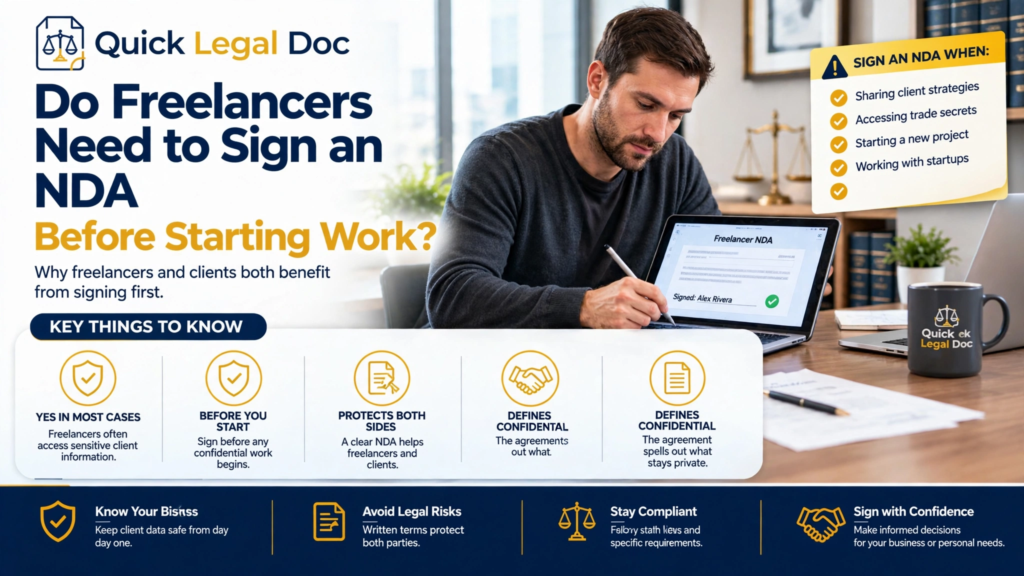
Yes, freelancers should sign an NDA before starting work whenever they will see confidential information like customer data, business plans, source code, or trade secrets. Unlike employees, freelancers owe you no automatic duty of loyalty, so without a signed agreement you may have no recourse if they share what they learn.
This article explains when do freelancers need an NDA, what makes freelancer agreements different from employee ones, what the document should cover, and what to do when a freelancer pushes back on signing.
When Do Freelancers Need an NDA Before Starting Work?
The short answer is whenever they will touch anything sensitive. If a freelancer will see your customer list, your pricing, your unreleased product, your marketing strategy, or the inside of your systems, get the NDA signed before the first file is shared. After is too late. Once information is out, no agreement can pull it back.
The timing matters more than people think. Many businesses share first and paper later, sending logins and documents in the excitement of kicking off a project, then remembering the NDA a week in. Anything disclosed before signing sits in a gray area. Sign first, share second, every time.
There are narrow cases where you can skip it. A freelancer doing purely public-facing work with no access to internal data, like writing blog posts from public sources, may not need one. But when in doubt, the cost of an NDA is minutes, and the cost of a leak is far more. Default to signing.
Why Is the Answer Different for Freelancers Than Employees?
Employees operate inside a relationship the law already understands. Most states recognize that employees owe their employers duties of loyalty and confidentiality, at least to some degree, even without a signed agreement. Freelancers sit outside that framework entirely. They run their own businesses, serve multiple clients, and owe you only what a contract says they owe you.
That independence cuts both ways. A freelancer who learns your secrets on Monday can start work for your competitor on Tuesday, and without an NDA, you may have no contractual claim against them. Trade secret law might help in extreme cases, but it is a much harder and more expensive fight than enforcing a clear agreement.
Cornell Law School’s Legal Information Institute has a useful overview of independent contractor status and how it differs from employment, which explains why the default legal protections around employees simply do not extend to freelancers.
The practical takeaway is simple. With employees, an NDA sharpens protections you partly have. With freelancers, the NDA creates protections you otherwise lack. That makes it more important, not less.
What Should a Freelancer NDA Cover That a Normal Contract Misses?
A standard freelance contract covers deliverables, deadlines, and payment. It rarely says a word about confidentiality, and when it does, the language is often a single vague sentence. A proper NDA defines exactly what counts as confidential, ties it to the project, sets a clear duration, and spells out what happens on breach.
Ownership deserves its own attention. Remember that without a written assignment, a freelancer generally owns what they create, even if you paid for it. Your NDA should either include work product assignment language or sit alongside a contract that does. Confidentiality without ownership means they cannot talk about the work but still own it, which is a strange place to be.
Also address the freelancer’s other clients. A good freelancer NDA acknowledges they serve multiple clients and focuses restrictions on your specific information, not on their general skills or their ability to earn a living. Overbroad restrictions aimed at freelancers look like control, and control is what courts examine when someone claims a freelancer was really an employee.
Should the Client or the Freelancer Provide the NDA?
Usually the client provides it, because the client is the one with secrets to protect. Having your own template ready means the terms match your needs, the scope fits your business, and the duration reflects how long your information stays sensitive. Waiting for the freelancer to produce one puts your protection in someone else’s hands.
Sometimes experienced freelancers bring their own mutual NDA, especially in consulting-style work where both sides share sensitive information. That is fine, but read it carefully. A freelancer-drafted agreement may define confidential information in ways that protect their methods more than your data. Mutual is fair, but only if the terms are genuinely balanced.
Either way, keep it simple and project scoped. Our freelance contract template guide explains how confidentiality language fits alongside the other protections a client needs, so your NDA and your contract work together instead of contradicting each other.
What If a Freelancer Refuses to Sign an NDA?
First, ask why. Most refusals come from a specific concern, not from a desire to leak your secrets. The scope may feel too broad, the duration too long, or the freelancer may worry the agreement blocks them from working with other clients. Each of these is negotiable, and a short conversation often resolves it.
Narrow the agreement to address the concern. If the scope feels sweeping, tie it to the specific project. If the duration feels endless, set two to three years. If they fear it limits their livelihood, add language confirming it covers only your confidential information, not their general skills or other client work. Reasonable freelancers sign reasonable NDAs.
If they still refuse, take it seriously. A freelancer who will not agree to keep your information confidential is telling you something about how they operate. You can limit their access to sensitive material, restructure the work so they see less, or find someone else. What you should not do is share your secrets anyway and hope for the best.
How Do You Get the NDA Signed Without Slowing Down the Project?
Make it part of onboarding, not a separate legal event. Send the NDA with the contract and the project brief, as one package, before any work discussion that touches sensitive details. When signing is simply step one of starting work, nobody treats it as a hurdle.
Keep the document short and readable. A two-page NDA in plain language gets signed the same day. A twelve-page monster full of legalese gets forwarded to a lawyer friend, questioned for a week, and sometimes never signed at all. Clarity is not just good drafting, it is good project management.
The Quick Legal Doc NDA generator builds a clean, tailored freelancer NDA in minutes, with project-scoped language and fair terms that experienced freelancers actually sign. You answer a few plain-language questions, and the agreement is ready before the kickoff call.
Frequently Asked Questions
Q: Do freelancers need an NDA if the contract has a confidentiality clause?
A: A strong, detailed confidentiality clause can be enough, but most contract clauses are too vague to rely on. A standalone NDA defines the protected information precisely, sets duration and remedies clearly, and is easier to enforce. When the information matters, use the dedicated document.
Q: Can I use the same NDA for freelancers and employees?
A: You can, but it is better to tailor them. Freelancer NDAs should be project scoped, address work product ownership explicitly, and avoid restrictions that look like employment control. An employee NDA applied blindly to a freelancer can be overbroad and harder to enforce.
Q: Does an NDA stop a freelancer from working with my competitors?
A: No. An NDA restricts sharing your confidential information, not taking on other clients. If you need limits on competitive work, that requires separate non-compete language, which is difficult to enforce against freelancers and can raise misclassification concerns.
Q: How long should a freelancer NDA last?
A: Two to three years after the project ends is typical for ordinary business information, since freelance engagements are usually short and the information goes stale faster. Genuine trade secrets can carry longer or indefinite protection under a separate obligation.
Q: What happens if a freelancer shares my information without an NDA?
A: You may still have claims under trade secret law if the information qualifies, but the case is harder, slower, and more expensive than enforcing a signed NDA. Without a contract, you must prove the information was a protected secret and that the freelancer knew it, which is an uphill fight.
The templates and articles on Quick Legal Doc are provided for informational purposes only and are not legal advice. Every business situation is different, so consult a licensed attorney in your state before relying on any NDA for your specific circumstances.