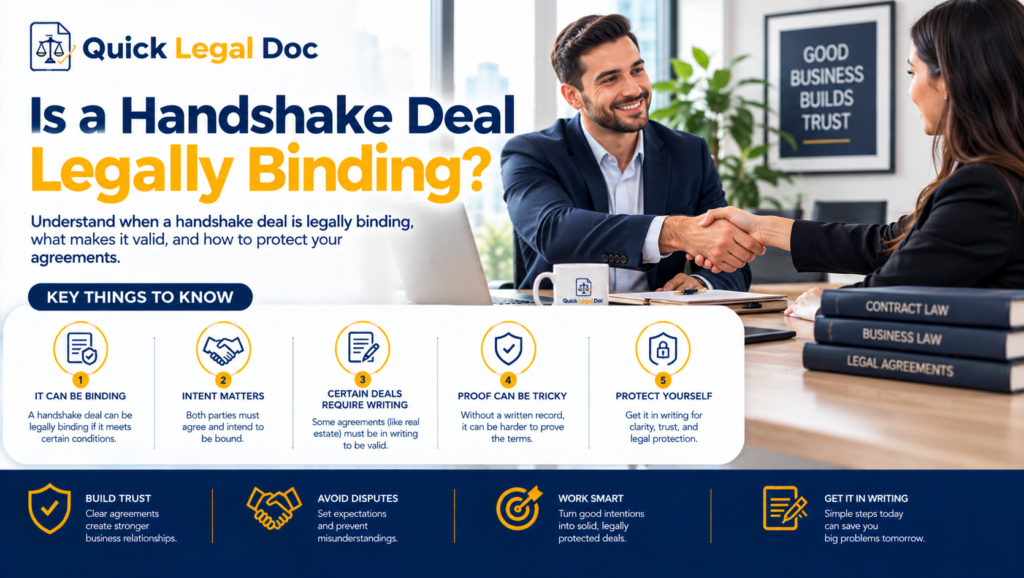
You agree on price, shake hands and start the work. No paper, no signature, just a spoken deal between two people who trust each other. A handshake deal legally binding in most cases, the same way a written contract is, as long as it includes an offer, acceptance and something of value exchanged by both sides. The catch isn’t whether it’s binding. It’s whether you can actually prove it happened the way you remember.
This covers when a verbal agreement holds up, the specific legal exceptions that require something in writing no matter what and what to do if a handshake deal falls apart.
What Makes a Verbal Agreement Handshake Deal Legally Binding?
A contract, spoken or written, needs the same basic elements to be enforceable: an offer, acceptance of that offer, consideration, meaning something of value exchanged by both sides and mutual intent to actually be bound by the deal. None of these elements require paper or a signature. If you agree to pay someone $500 to paint your fence and they agree to do it, that exchange already has everything a court needs to call it a contract, assuming you can prove it happened.
The Real Problem Isn’t Legality, It’s Proof
A verbal agreement being legally valid and a verbal agreement being easy to enforce are two completely different things. If a dispute ends up in front of a judge, it becomes your word against the other party’s and courts look for supporting evidence: text messages, emails, invoices sent afterward, witnesses present during the agreement or proof that one side already started performing their end of the deal. Without any of that, a handshake deal can be real and still practically unenforceable simply because nobody can prove what was actually agreed to.
When the Law Requires Writing, No Matter What
Certain categories of agreements are legally required to be in writing under a rule called the Statute of Frauds, regardless of how clear or mutual the verbal agreement was. This generally includes any sale or transfer of real estate, contracts that by their own terms cannot possibly be completed within one year, agreements to pay someone else’s debt and the sale of goods worth $500 or more under the Uniform Commercial Code. Cornell Law School’s Legal Information Institute lays out the full scope of the rule in its overview of the statute of frauds, which is worth checking before assuming a handshake covers you for anything significant.
Outside of these specific categories, a verbal agreement can be just as binding as a written one. Inside them, no amount of mutual trust changes the fact that the law simply won’t enforce it without something in writing.
What Evidence Actually Holds Up
If a handshake deal legally binding is disputed, the strongest evidence usually isn’t a dramatic recording or a surprise witness. It’s the boring paper trail that builds up naturally: a text confirming the price, an email summarizing what was discussed, an invoice sent and acknowledged or bank records showing a deposit was paid and accepted. Courts also give real weight to partial performance, meaning if one side already started doing the work or already paid part of the money, that behavior itself supports the claim that an agreement existed.
The Simple Habit That Fixes Most of This
You don’t need a formal contract to protect a handshake deal. A short follow-up message sent right after the conversation, something like “confirming we agreed on $500 for the fence, done by Friday,” creates a written record without turning a casual agreement into a legal production. If the other person doesn’t object to that message, it becomes meaningful evidence that both sides understood the deal the same way.
When a Handshake Deal Genuinely Isn’t Enough
For anything involving real money, an ongoing relationship or terms with real nuance, like payment schedules, deliverables or what happens if either side backs out, a verbal agreement leaves too much room for two people to genuinely remember the deal differently months later. This isn’t about distrust. It’s about the fact that memory is unreliable even between people acting in complete good faith and a written agreement removes that uncertainty before it has a chance to cause a dispute.
Handshake Deals Between Businesses vs Between Friends
Courts generally treat a verbal agreement between two businesses the same way they’d treat one between friends, but the practical stakes tend to differ quite a bit. A business handshake deal is far more likely to involve larger sums, ongoing obligations and professional reputations on the line, which means a dispute is also more likely to actually end up in front of a judge rather than being worked out over coffee. Business owners relying on verbal agreements regularly are taking on real risk every time, even when the relationship has worked fine for years, simply because one bad disagreement can undo a lot of goodwill fast.
This doesn’t mean every single business interaction needs a formal contract. It means the threshold for when it’s worth the five minutes to write something down should be lower in a business context than it might be between two friends splitting a small favor.
Setting Up Agreements the Right Way From the Start
Moving a handshake deal into writing doesn’t need to be complicated or expensive. Our full library of free legal document generators covers the most common agreement types, from freelance work to rental arrangements, letting you formalize a deal in minutes instead of relying on memory if things ever go sideways.
What to Do If a Handshake Deal Falls Apart
If the other party backs out or disputes what was agreed, start by gathering whatever evidence exists, messages, receipts or anyone who witnessed the conversation and send a clear written demand referencing the agreement and what’s owed. Our guide on how to write a demand letter that actually gets results walks through that process if a direct conversation doesn’t resolve things on its own.
A Real Example of How This Plays Out
Say a contractor verbally agrees to redo a bathroom for $4,000, no deposit, no written estimate. Halfway through, the homeowner claims the agreed price was $3,000 and refuses to pay the difference. With nothing written down, this comes down entirely to credibility and whatever indirect evidence exists. If the contractor has a text message confirming the scope and price or an email thread discussing materials at that budget, the case becomes much stronger. Without any of that, it’s one person’s word against another’s and the outcome becomes far less predictable.
This is exactly the kind of situation a two minute confirmation message would have prevented entirely and it’s why the habit matters more than people expect until they’re the ones stuck without it.
Common Mistakes to Avoid
The most common mistake is assuming a handshake deal is automatically unenforceable, when in most cases it isn’t. The opposite mistake is just as common: relying entirely on memory for anything involving real money or complex terms, with nothing written down anywhere. Both lead to the same outcome, a dispute that’s much harder to resolve than it needed to be.
Frequently Asked Questions
Q: Can you sue someone over a verbal agreement?
Yes, as long as the agreement doesn’t fall under the statute of frauds. You’ll need evidence to prove the terms, but the lawsuit itself is legally possible.
Q: Does a handshake deal need a witness to be valid?
No, a witness isn’t required for the agreement to be legally binding, but having one makes it significantly easier to prove if the deal is ever disputed.
Q: Is a text message agreeing to something the same as a written contract?
It can count as sufficient written evidence for many types of agreements, though not for ones specifically requiring a signed document under the statute of frauds, like real estate.
Q: What if the other person denies the handshake deal ever happened?
This is exactly why evidence matters. Without messages, witnesses or proof of partial performance, a flat denial can be very difficult to overcome in a dispute.
Q: Are verbal business agreements common in any industries?
Yes, especially for small, low-stakes transactions and within close-knit industries built on reputation. Even there, a quick written follow-up is cheap insurance against a misunderstanding later.