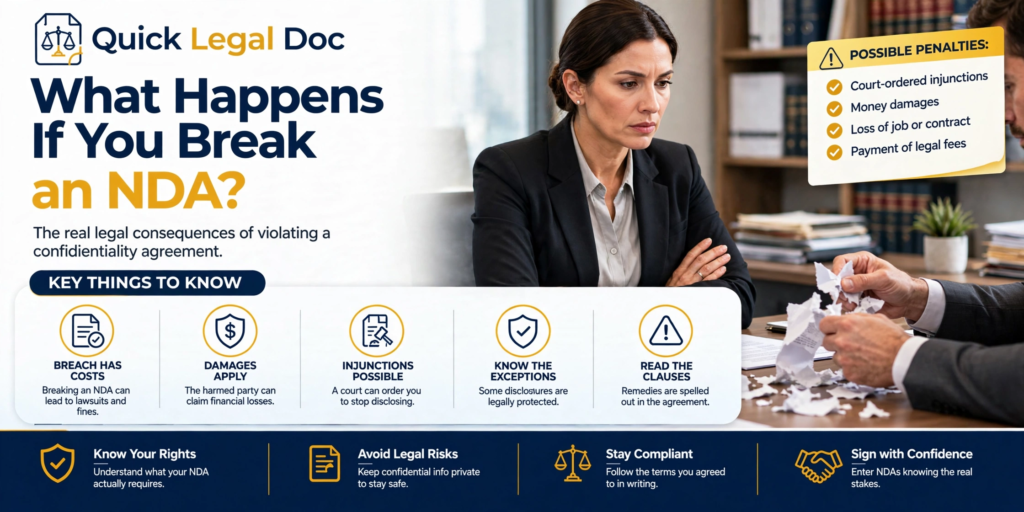
If you break an NDA, the other party can sue you for breach of contract, ask a court to recover money damages, and in many cases get an injunction to stop you from sharing anything further. Depending on the agreement and your state, you could also be on the hook for their legal fees.
This article walks through what happens if you break an NDA in the order it usually plays out. You will learn what the other side can demand, which consequences are realistic and which are rare, and the defenses people rely on when a dispute lands on their desk.
Can the Other Party Really Sue You for Breaking an NDA?
Yes. An NDA is a contract, and breaking one is a breach of that contract. The party you disclosed information to can file a lawsuit asking the court to hold you responsible. This is true whether you signed an employment NDA, a contractor agreement, or a mutual NDA before a business deal.
That said, filing a lawsuit costs money, so not every broken NDA turns into a court case. Small or harmless slips often end with an angry letter and nothing more. But if the disclosure caused real damage, or they want to make an example, a lawsuit is very much on the table. Never assume they will let it go.
Cornell Law School’s Legal Information Institute keeps a clear overview of breach of contract and the remedies courts can award, which is worth a read if you want to understand the legal framework an NDA dispute sits inside.
What Kind of Money Damages Can They Recover?
The most common consequence of breaking an NDA is money damages. The other party can ask the court to order you to pay for the harm the disclosure caused, actual losses like a lost contract or a competitor undercutting them with your information, and in some cases the profit you gained from the disclosure.
Many NDAs also include a liquidated damages clause, which sets a fixed penalty in advance, say $25,000 or $50,000 per breach. Courts generally enforce these if the amount was a reasonable estimate made at signing time, not a punishment invented after the fact.
Even without such a clause, damages can climb fast. If leaked trade secrets cost a company its competitive edge, the number the court lands on can be far larger than most people expect when they forward a document they should not have.
What Is an Injunction, and How Quickly Can One Hit You?
Money comes later, but an injunction can arrive fast. An injunction is a court order telling you to stop disclosing the information immediately. If the other side believes you are about to share secrets, or you already started, they can ask a judge for emergency relief, sometimes within days of learning about the leak.
Some NDAs include a clause where you agree in advance that any breach would cause irreparable harm. Even without that language, courts routinely grant injunctions in NDA cases because some kinds of information, once public, cannot be unshared.
Violating an injunction is a separate and serious problem. Ignore a court order and you can face contempt charges, fines, and in extreme cases jail time. So the moment an injunction lands, everything you thought the NDA meant is secondary to doing exactly what the judge says.
Can You Face Criminal Charges for Breaking an NDA?
A broken NDA by itself is a civil matter, not a crime. You get sued, you do not get arrested, for the breach alone. But the underlying act that broke the NDA can cross into criminal territory. Stealing trade secrets, for example, can be prosecuted under federal law if the conduct meets the legal definition, regardless of what your NDA said.
Similarly, if the disclosure involved hacking into systems, bribing someone for access, or handing secrets to a foreign government, prosecutors can get involved. These are extreme cases, but they exist, and an NDA does not shield you from them. If anything, the NDA proves you knew the information was confidential, which prosecutors love.
For the average workplace slip, criminal charges are extremely unlikely. The risk rises with intent. Accidentally mentioning something at a party is a civil problem. Deliberately selling a customer list to a competitor can attract attention far beyond a lawsuit.
Will You Have to Pay the Other Side’s Legal Fees?
Quite possibly. Many NDAs include an attorney’s fees clause, which says the losing party pays the winner’s legal costs. If you broke the agreement and lose the case, you could owe not just damages but also the other side’s lawyers, and business litigation lawyers are not cheap.
Even without a fees clause, some states let the winning party recover fees in trade secret cases, especially when the theft was willful and malicious. A deliberate leak can carry a fee bill on top of everything else, turning an already expensive loss into a devastating one.
This is one of the reasons disputes often settle before trial. Once both sides see the meter running on legal costs, a negotiated payment starts to look a lot better than a courtroom. If you receive a demand letter alleging a breach, treat it as the opening of a negotiation, and get advice before you respond.
What Defenses Actually Work When You Are Accused of Breaking an NDA?
A few defenses show up again and again. The information was already public, or became public through no fault of yours, is a strong one. An NDA cannot protect what everyone already knows. Another is that you learned the same information independently, from your own work, without using the confidential material.
People also challenge the NDA itself, arguing it was too vague about what counts as confidential, unreasonably long, or signed under pressure. These arguments sometimes succeed, but courts enforce plenty of NDAs that the losing side thought were unfair. Do not bank on a judge bailing you out.
The weakest defense is that you did not mean to share it. Accidental disclosure is still disclosure. If you told a friend something marked confidential at a dinner, the fact that you were not scheming does not undo the breach. Carelessness is not a legal shield.
If you want to understand what a well-drafted NDA actually obligates you to do, our non disclosure agreement guide breaks down the standard clauses and what each one commits you to, so you can spot risky language before you sign.
What Happens If You Break an NDA and Want to Limit the Damage?
First, stop the bleeding. Do not share more, do not post about it, and do not try to retrieve what you sent with panicked messages that become evidence. Save copies of what you signed, and write down exactly what you disclosed, to whom, and when, while the memory is fresh.
Second, get real legal advice quickly, especially if you have received any letter from the other side. A lawyer who handles contract disputes can tell you whether the NDA is enforceable, what your exposure looks like, and whether an early, quiet resolution is possible. Many NDA disputes settle because both sides would rather pay something now than fund a lawsuit.
And for next time, sign NDAs that are clear and fair in the first place. The Quick Legal Doc NDA generator builds agreements with defined terms, reasonable scope, and plain language, so everyone knows exactly what counts as confidential and what the rules are. Knowing the rules before you sign is the cheapest protection there is.
Frequently Asked Questions
Q: What happens if you break an NDA by accident?
A: An accidental breach is still a breach, so the other party can still sue. That said, courts and the other side often treat genuine accidents more leniently than deliberate leaks, and many accidental disclosures settle quietly. Document what happened and get advice before you admit anything in writing.
Q: How much can you be fined for breaking an NDA?
A: There is no fixed fine, since NDA breaches are civil matters, not criminal ones. You pay damages based on the harm caused or the amount set in a liquidated damages clause, which can range from a few thousand dollars to far more in trade secret cases, plus possible legal fees.
Q: Can an NDA be enforced if the information is already public?
A: Generally no. Information that is already public, or that becomes public through no fault of yours, usually falls outside an NDA’s protection. This is one of the strongest defenses in a breach dispute, though the party claiming it often has to prove the information was truly public.
Q: Do NDAs expire, or can they haunt you forever?
A: Most NDAs have a set obligation period, commonly two to five years after the relationship ends, though genuine trade secrets can be protected indefinitely. Once the term expires, the agreement no longer binds you, so check the duration clause in the document you signed.
Q: Should you respond to a letter accusing you of breaking an NDA?
A: Do not ignore it, and do not fire off a denial on your own. Have a lawyer review the letter and the NDA first. Many disputes are resolved with a single well-handled response, while a careless reply can admit things you did not mean to admit.
The templates and articles on Quick Legal Doc are provided for informational purposes only and are not legal advice. Every business situation is different, so consult a licensed attorney in your state before relying on any NDA for your specific circumstances.