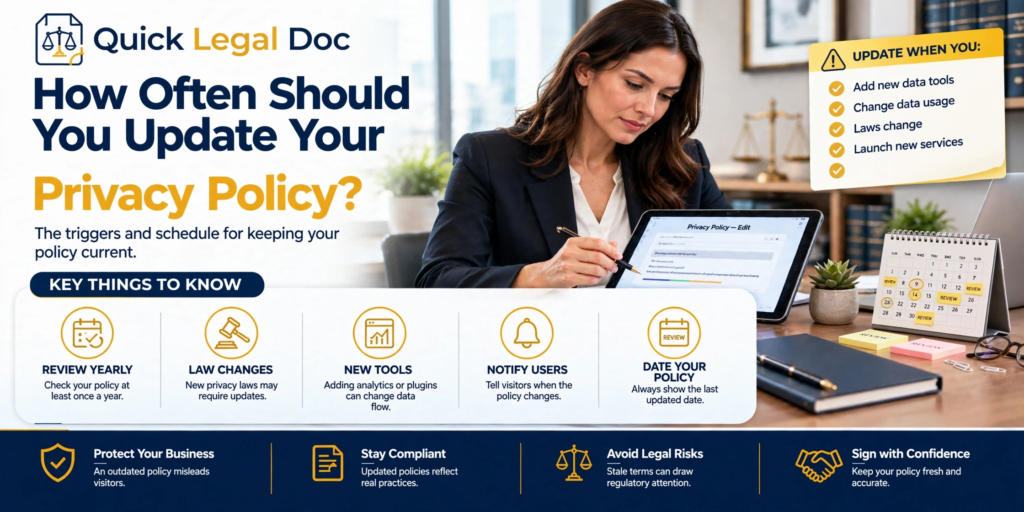
Review your privacy policy at least once a year, and update it immediately whenever your data practices change. A new analytics tool, a new email platform, a new ad network, or a new form all make your existing policy inaccurate the moment they go live.
This article covers how often to update privacy policy documents in real-world terms: the events that should trigger an immediate update, why the annual review matters, how to notify visitors of changes, and the mistakes that make updates backfire.
How Often to Update Privacy Policy Documents at a Minimum?
Once a year is the sensible minimum. Set a recurring reminder, pick a quiet month, and read your policy top to bottom against what your site actually does today. In twelve months, small sites routinely add a plugin, switch an email provider, or start running ads, and each of those quietly invalidates part of the policy.
The annual review is also when you catch slow drift. Nobody announces that the contact form plugin started storing entries differently, or that the analytics retention setting changed during an update. These small shifts accumulate until the policy describes a site that no longer exists. A yearly read-through resets the baseline.
Think of it like a smoke detector battery. The yearly check is not because something is definitely wrong, it is because the cost of checking is tiny and the cost of discovering a problem during an incident is enormous. Ten minutes of reading, once a year, keeps the document honest.
Which Changes Should Trigger an Immediate Update?
Any change to what you collect, how you use it, or who you share it with. Installing analytics where there was none, adding a newsletter signup, connecting form submissions to a CRM, starting to run ads, adding a payment option, embedding a third-party video player that tracks viewers, each of these changes the facts your policy states, so the policy must change with them.
Changes to your business count too. If you start selling products, launch a membership area, or begin sharing data with a new partner, the policy needs new sections. Even removing a practice matters: if you stopped using a tracking tool, saying you still use it is just as inaccurate as omitting one you added.
The rule is simple: update the policy in the same deployment as the change, not weeks later. When the new plugin goes live on Tuesday, the updated policy goes live on Tuesday. A gap between the practice and the disclosure is exactly what regulators and complainants look for.
Do New Privacy Laws Require You to Update Your Policy?
Often, yes. The US privacy landscape keeps expanding, with new state laws taking effect regularly. Each new law can add disclosure duties, new consumer rights to describe, or new rules about data sales and sharing. When a law covering your visitors takes effect, your policy should reflect it.
California’s rules are the ones most small sites feel first, since California visitors are nearly unavoidable for US sites. The California Attorney General’s guidance on the CCPA is worth checking whenever you hear about amendments or new regulations, because the required disclosures have evolved since the law first took effect.
You do not need to track every legislature yourself. A yearly review that includes a quick check of whether new laws affect you is enough for most small sites. If your business grows into new regions or new data practices, that is the moment to look deeper, possibly with legal help.
How Should You Notify Visitors About Updates?
For routine updates, posting the new version with a fresh last-updated date is enough. Most policy changes are clarifications or reflections of small practice changes, and visitors do not need an email blast about each one. The updated date itself is the notice.
For material changes, do more. If you start sharing data with a new category of third party, begin a new use like targeted advertising, or reduce visitors’ rights in any way, notify them directly. Email subscribers about the change, show a notice banner for a few weeks, and consider asking for fresh consent where the law requires it.
What counts as material is a judgment call, but err on the side of over-communicating. A short, honest email about a policy change builds trust. A silently rewritten policy discovered by a curious visitor destroys it. When in doubt, tell people.
What Mistakes Do People Make When Updating?
The biggest is updating the date without updating the content. Changing “last updated” to today while leaving stale descriptions in place is worse than doing nothing, because now the document affirmatively claims to be current. If you touch the date, earn it by doing the review.
The second is forgetting where the policy is referenced. Cookie banners, consent checkboxes, signup forms, and footers all point to the policy, and some quote from it. If you change what the policy says about cookies but the banner still describes the old practice, you have created a contradiction. Update the references alongside the document.
The third is losing the old version. Keep an archive of prior policies with their dates. If a dispute arises about what you disclosed last year, you will be glad you can produce it. Version history is cheap insurance, a simple dated copy in your files.
For site owners running ads, keeping the policy current is doubly important, since ad platforms review it during approvals and policy checks. Our privacy policy guide for AdSense publishers explains how an outdated policy can stall or sink an application, which is one more reason the annual review pays for itself.
What Is the Fastest Way to Handle an Update?
Do not patch the old document by hand if your practices changed significantly. Regenerating from your current answers is cleaner than editing sentences written for a different version of your site. List what changed, answer the questions fresh, and publish the new version.
The Quick Legal Doc privacy policy generator makes this painless. When you add a tool or change a practice, run through the questions again with your updated answers and publish the new policy the same day. The whole process takes minutes, which removes the only real excuse for letting a policy go stale.
Then set next year’s reminder before you forget. The sites with accurate policies are not the ones with legal teams, they are the ones with a calendar entry.
Frequently Asked Questions
Q: How often to update privacy policy pages if nothing changed?
A: Review yearly even when nothing changed, and update the last-reviewed date to show it. Practices drift in ways you do not notice, and the review is what catches them. A policy untouched for three years is a red flag regardless of whether anything obviously changed.
Q: Do I need to email users every time I update my policy?
A: No, not for routine updates. Posting the new version with an updated date is standard. Reserve direct notification for material changes, like new data sharing or new uses of data, where visitors’ expectations genuinely shift.
Q: Should I keep copies of old privacy policies?
A: Yes. Archive each version with its effective dates. Old versions matter if a dispute arises about what you disclosed at a particular time, and they show a history of good-faith compliance that helps in any review.
Q: Does updating my policy require user consent?
A: Routine updates that do not expand data use generally do not require fresh consent. If the update introduces a materially new use of data, especially marketing or sharing, getting renewed consent is the safer path and is required in some jurisdictions.
Q: What if I forgot to update my policy for years?
A: Fix it now. Review your current practices, publish an accurate policy with today’s date, and set a yearly reminder. Regulators and visitors care far more that the policy is accurate today than that it was stale last year, so the best time to fix it is immediately.
The templates and articles on Quick Legal Doc are provided for informational purposes only and are not legal advice. Every business situation is different, so consult a licensed attorney in your state before relying on any privacy policy for your specific circumstances.