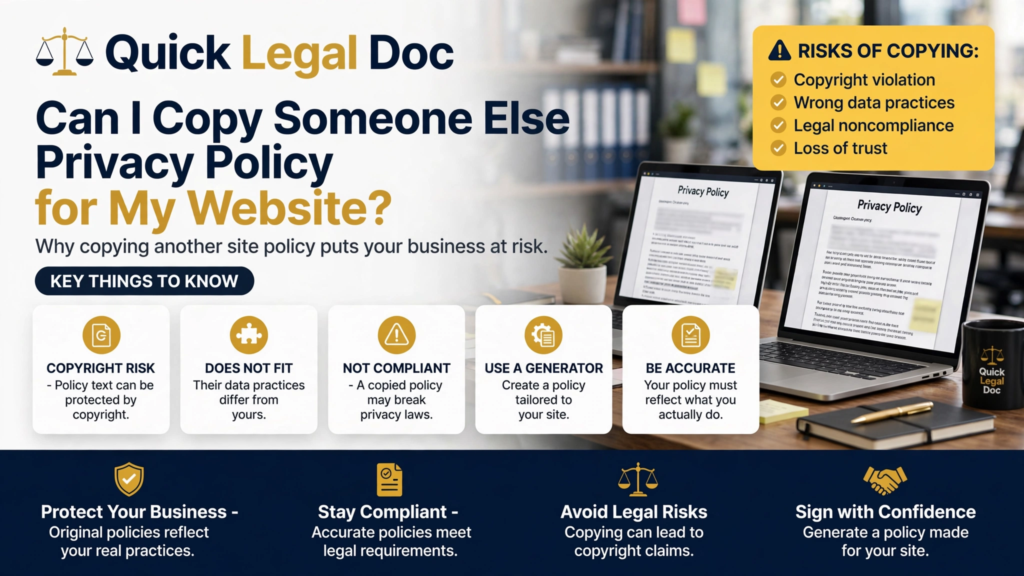
No, you should not copy a privacy policy from another website. A copied policy describes someone else’s data practices, not yours, which means it misleads your visitors and can leave you exposed under privacy laws. It can also be copyright infringement, since website text is protected creative work.
This article explains why the answer to can I copy a privacy policy from another website is no, what actually goes wrong when people do it, and the fast, legitimate ways to get a policy that fits your site.
Can I Copy a Privacy Policy From Another Website and Just Change the Name?
A privacy policy is a statement about your specific practices. It tells visitors what you collect, how you use it, and who you share it with. When you copy another site’s policy, every one of those statements describes their business, not yours. Your policy then promises things you do not do and omits things you actually do.
That mismatch is the core legal problem. Privacy laws in California, the EU, and a growing list of US states require your disclosures to be accurate. A policy that says you do not use analytics while your site runs Google Analytics, or that names a payment processor you have never used, is a false statement to your visitors and to regulators. Accuracy is the entire point of the document.
Think of it this way: a privacy policy is not a decoration that makes your site look legitimate. It is a public record of your data practices. Copying someone else’s turns it into fiction, and fiction is exactly what gets small businesses in trouble when a complaint or an audit arrives.
Can Copying a Privacy Policy Be Copyright Infringement?
Yes. Website text, including privacy policies, is creative work protected by copyright from the moment it is written. Copying substantial portions of another site’s policy without permission is infringement, even if you change the company name at the top. The original author can send takedown notices and, in serious cases, pursue damages.
Many site owners assume legal-sounding text is somehow exempt, or that small changes make it original. Neither is true. Swapping in your business name does not create a new work, and the plainer the copied text, the easier it is to prove where it came from. Privacy policies are particularly easy to trace because their structure and phrasing are distinctive.
Cornell Law School’s Legal Information Institute maintains a clear overview of copyright law and what it protects, which confirms that original website text qualifies. The risk may feel theoretical until you receive a cease and desist letter, and by then the cheap shortcut has become an expensive problem.
Some policies are published under open licenses or are government templates meant for reuse, and those are fine to use as directed. But a random competitor’s policy is not in that category. When in doubt, assume it is protected.
What Are the Most Common Things a Copied Policy Gets Wrong?
The copied policy almost always misstates what data is collected. It may describe newsletter signups you do not have, omit the contact form you do have, or reference analytics tools you have never installed. Every inaccuracy is a false disclosure sitting on your site, visible to anyone who compares the policy to reality.
Third-party sharing is the next casualty. The original site’s policy names their email platform, their ad network, their payment processor. Yours uses different services, or none at all, but the copied text keeps naming theirs. A visitor reading it learns nothing true about where their data actually goes.
Contact details and update dates go stale instantly. The copied policy lists someone else’s privacy email and someone else’s last-updated date. Visitors trying to exercise their rights email a stranger, and the whole document looks abandoned. These small details are exactly what make a policy feel trustworthy, and copying destroys all of them.
Will Anyone Actually Notice or Care?
Sometimes the copying is discovered by the original author, who recognizes their own distinctive phrasing and sends a complaint. Privacy policy text is surprisingly recognizable, since businesses often include unique descriptions of their practices. Automated plagiarism tools make this easier every year.
Regulators can notice too, though usually indirectly. When a consumer files a complaint about your data practices, the first thing an investigator reads is your policy. A policy that contradicts your actual practices, or that is word-for-word identical to an unrelated business, signals that you never took the obligation seriously. That shapes how the rest of the investigation goes.
And visitors notice more than you might expect. People do read privacy policies when they are deciding whether to trust a site with their email address or their money. A policy that mentions another company’s name, which happens more often than anyone admits, destroys trust instantly. If you run ads, our privacy policy guide for AdSense publishers shows how much a credible, accurate policy matters when platforms and visitors are judging your site.
What Should You Do Instead of Copying?
Use a competitor’s policy as a checklist, not a template. Reading a good policy shows you which sections exist, data collection, use, sharing, rights, contact, and you can make sure your own policy covers the same ground. Learning the structure is fine. Lifting the sentences is not.
Then write your policy from your actual practices. List what your site really collects, name the tools you really use, describe what you really do with the data. This sounds like more work than copying, but for a small site it takes less than an hour, because your practices are simple and you know them better than anyone.
The fastest legitimate route is a generator built for this. The Quick Legal Doc privacy policy generator asks about your site in plain language and produces an original policy matched to your actual data practices, no copying, no copyright risk, no false statements. You get a document you can stand behind because it describes what you truly do.
Frequently Asked Questions
Q: Can I copy a privacy policy from another website if I change the business name?
A: No. Changing the name does not fix the two core problems: the policy still describes the wrong data practices, and the text is still someone else’s copyrighted work. A find-and-replace job is the most common version of this mistake, and it fails on both counts.
Q: Is it illegal to copy a privacy policy?
A: It can be. The text is protected by copyright, so substantial copying without permission is infringement. Separately, publishing false privacy disclosures can violate consumer protection and privacy laws. It is one shortcut with two different kinds of legal exposure.
Q: What if I copy a policy from a very large, reputable company?
A: That is worse, not better. A large company’s policy describes practices, tools, and legal obligations that almost certainly do not match your small site, so the inaccuracies multiply. Large companies also have legal teams that notice and act on copying.
Q: Are there free privacy policies I can legally use?
A: Yes, but only ones explicitly offered for reuse, such as government templates or policies published under open licenses, and you must still customize them to your actual practices. A generator that builds an original policy from your answers is usually the better option.
Q: I already copied a policy. What should I do now?
A: Replace it as soon as possible with an original policy based on your real practices. Take the copied version down first, then publish the replacement. The sooner the inaccurate text is gone, the smaller your exposure, so do not wait for a complaint to force the issue.
The templates and articles on Quick Legal Doc are provided for informational purposes only and are not legal advice. Every business situation is different, so consult a licensed attorney in your state before relying on any privacy policy for your specific circumstances.